
Fear makes the wolf seem bigger than it is.
So goes the proverb of which I remind myself every day. One antidote for fear is action. I don’t necessarily mean brave and useful action. Living a good life and being an example of fairness and clarity are a great idea too.
I’m going to give you a little snapshot of the strange and wonderful, inspiring and disheartening experiences I’ve had in the past month. I also want to encourage you to interact with me here. I moved The Hope Desk to Substack because it was a useful platform for the newsletter, but Substack has also grown and evolved since that time. It’s free to interact and doesn’t feel as toxic to me as the Meta platforms. There’s a link for comments at the bottom of the page too.
Here we go…
I attended and presented at the National Conference on Race and Ethnicity in New York. As you might imagine, a lot of folks at universities who talk about these topics (and more) have been de-funded or find themselves more precarious now (including me). Was the tone sombre? No. The U.S. has consistently, through our whole history, dealt with white supremacist erasure of history and experiences we should be discussing and rectifying. These times are difficult, and not new. I also felt so inspired by a speaker from the ACLU, I increased my monthly donation to the organization.
I traveled to San Antonio for their pride celebration, met some great people, and ate amazing vegan food. Yes, you read that right. San Antonio is both Texas and acting in opposition to the worst of Texas. I interviewed a lesbian mom who said, “We live here because of San Antonio, not because of Texas.” I wrote a travel article about the trip, and my collection of interviews with queer parents about their families in these times is still ongoing.
My partner and I are settling into more time in Chicago, with my magnificent grandchildren and their protectors. We are staying in a small space and enjoying it pretty well. I’m tired of having a big house to maintain. (And that house is still available - we’ll shift to finding renters rather than buyers soon. Let me know if you’re interested in a magnificent sea view in rural East Hawaii for at least six months…)
Vijay and I traveled to Winston Salem NC as well for more good eating and queer pride. I wrote a forthcoming travel article, in which I briefly comment on some of what I loved, and some of what dismayed me. In particular about how cultural/historical organizations in the U.S. - where people were tortured for centuries - still (fail to) discuss their history.
I posted a quick little TikTok video about Leanna Perry’s assault on a seat mate recently on a Southwest Airlines flight and holy moly, a few thousand people were mad at me for using the word fat. (Many were also happy for my analysis.) I posted a few more follow-up messages. The short of it is: simply never calling someone fat does not equate kindness. It’s a good idea to refer to people as they wish to be called. And yes, we absolutely have to talk about fat people’s experiences and weed hatred from our own - and our public - gardens. If you are curious here are my follow-up Part 1, Part 2, Part 3 videos.
June’s not over as I type, and I am still looking for hope everywhere I can find it. Fear makes the wolf seem bigger than it is. I miss seeing some of you since I left Facebook and Instagram. I hope those of you who are able and interested join me online in July to explore memories and memoir. Ask for a scholarship if you need one. It’ll be a good time.
No matter where you are, and what you’re doing, I wish you some good times…
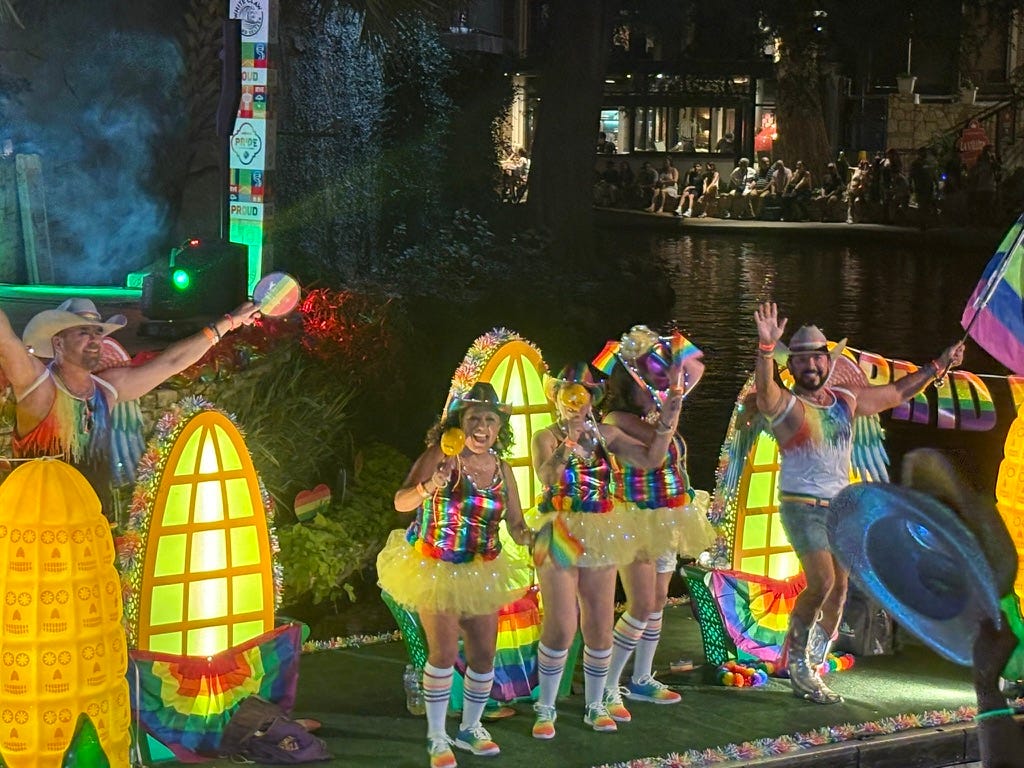
Photo is of the Kazamba Dance and Drum Group, San Antonio Texas.
Take a few steps
The relationship between inner values and resources and outer action is on my mind, as always. The current frenzy of anger, bitterness, confusion and unkindness in the U.S. makes it difficult to protect inner resources. I know I’m not alone in losing sleep, dwelling more often in worry, and feeling anxiety. Mindfulness and gratitude practices are more important in these times, to shore up inner resources.
Inner values are a resource too. Part of the reason the U.S. federal “permission to hate” trend is such a powerful culture-shifter is that it shifts inner values. Government officials say you don’t “have to” care about immigrants - or even U.S. citizens - being deported in order to feel like a good person. You don’t have to care about women dying during pregnancy and birth to feel like a good person. You don’t have to care about kids struggling with gender. Make no mistake, most people want to feel like we’re good. Even people who do horrible things tell stories to make themselves sound and feel like good people. One example (among many) is saying that lives are being saved by deporting immigrants because they’d have brought drugs to the U.S. This is unfounded and nonspecific, but it makes cruel acts seem good.
My suggestion this month regards how we use mental images, feelings and language to explore and steward our inner values. Here are a few suggestions for investigation.
Train your mind to notice the metaphors you hear and use. Especially notice the violent ones. How often do we hear/say things like, “that really blew up in his face,” or “it was a real beat down,” or even, “that really hit the target.”
How does it feel in your body to consider the actual meaning of metaphors in daily usage?
Is it possible to take off the shoes of your own voice (to paraphrase Ocean Vuong)? What would this look like and what voice could you put on that’s more aligned with your inner values?
What does it mean to argue or oppose or resist from a commitment to kindness? Or curiosity? Or creativity? Or surprise?
Let me know how your contemplations are going…
Media moments – thoughts, frames, recommendations, and critiques…
Sometimes in this section, I share new media that might interest you. British author, Charlotte Cooper, has a new book out I think some of you will really love. Fat Body Work: Somatics, Curiosity, Care and Practice follows Dr. Cooper’s Fat Activism: A Radical Social Movement, which remains a Fat Studies classic.
Here’s Cooper, responding to a few of my questions.
Your work, like mine, includes different styles of writing, and distinctly persona; perspectives as you explore fatness as a social phenomenon. How did you come to this way of working and how has it been received?
My earliest writing was done in secret because it wasn’t safe for me, as a child, to have an intellectual life. At that time I was lucky to come across a feminism that taught me the value of lived experience. This enabled me to value what I was doing. So I was writing poems and plays, and I started keeping journals that have continued for over forty years now and will be archived at the Bishopsgate Institute in London when I die. The reflective and creative practice that developed from those early days is how I think and it’s inevitable that this would leak into my public offerings and form part of how I make sense of phenomena. It’s there in my work as a psychotherapist too. Post-modernism is an important philosophical base for me and it invites people to think critically about universal narrativising. I like to make work that is like a patchwork or, to be really pretentious, bricolage and gestalt. The pieces make a whole, and the people encountering it add their own layers to make it really rich. I think of many of my projects, including Fat Body Work, as “expanded,” which is a term that comes from cinema. I research, write and publish texts that are supported by film, digital artefacts, events, objects, music, archive, performances and so on. I come from punk and DIY culture, so learning new skills and world-making is a big part of it.
How is this received?
It makes me illegible and ungovernable within the terms of dominant culture, which offers benefits and drawbacks. I have found ways of being myself but I am often isolated. Luckily there are people who love and respect what I do, they nourish and enable me to persist.
How do you see fatness as it relates to appearance hierarchy? What other social systems (or maybe scaffoldings) might you relate it to?
I find the expression “Follow the money,” helpful. I published a queer tour of monarchy in 2023, this included a really weird encounter with Queen Camilla, which clarified my thinking on hierarchies and who they serve. A basic understanding of capitalism and neoliberalism, also globalism, even populism can help us understand different forms of stratification and subjugation. Who is getting rich? Who stays at the top? How do they shore up their power? What are their methods and habits? Where are they weakest? This goes alongside other sociological scaffoldings of white supremacy, misogyny, healthism, ableism, homo- and transphobia, etc.
Appearance hierarchies affect different kinds of people who are touched by it in different ways. For example, the hatred of fat people isn’t only about appearance, so the hierarchies spread and form a matrix of oppression. Solidarity is an essential activist scaffolding in this context, empathy and openness to Others, mutual support, refusing co-option when the system offers shabby rewards, thinking expansively and inclusively.
We know that all of these things vary over time and place, they are contextualised in the moment and aren’t fixed or inevitable. It’s hard to recognize that when you’re stuck in it. But this understanding offers crumbs of comfort for revolutionaries living in dire situations. The worst of times can’t stop people from developing an imagination for other possibilities and looking for opportunities when the inevitable cracks appear.
One aspect of your work I’ve appreciated is what seems to be a distrust of academic perspectives on fat bodies. And still, your work makes a scholarly contribution. Can you speak to that?
That’s an interesting interpretation, I’d never thought of my work like that. The academy is a system that has so far failed to provide a future for me as a working class fat queer polymath, even though I have devoted years of my life to it. I don’t have the entitlement or the capital to work that system, including supportive mentors who would help me navigate it. Get in touch if that is you! I’m also not interested in exclusion or gatekeeping essential knowledge for profit; to saddle people with decades of debt because they want to learn or to publish £150 textbooks on marginalized people’s lives is an outrage. The work I come across can be dull, obvious and uninspiring. But there are also phenomenal academics producing electrifying work. Fat Body Work is dedicated to Cat Pausé, for example. Kathleen LeBesco and Jacqui Gingras’ work has been foundational to me. I deeply appreciate Esther Rothblum and Jenny Lee’s contributions to the field. I am moved when the line between academia and activism is blurred: the Wooleys and their relationship to the Fat Underground; Elana Dykewomon, Deb Burgard, Lynn McAfee and Hillel Schwartz’ para-academia; The Fat Studies Reader and, hopefully, the forthcoming Fat Performance book demonstrate that there are better ways of doing scholarship. There’s a new cohort producing really wonderful work: the editors of Excessive Bodies come to mind, Mikey Mercedes, Caleb Luna. So there is hope.
The issue is standpoint and access, meaning who speaks and who gets to benefit from the work. Both of these are classic concerns of the Research Justice movement, of which I am a part, as well as feminism and disability activism. Nothing about us without us! It means considering language, form, accessible ways of disseminating information. Knowledge in the service of social transformation and liberation. Without wanting to sound too cheesy, this is embedded in everything I do.
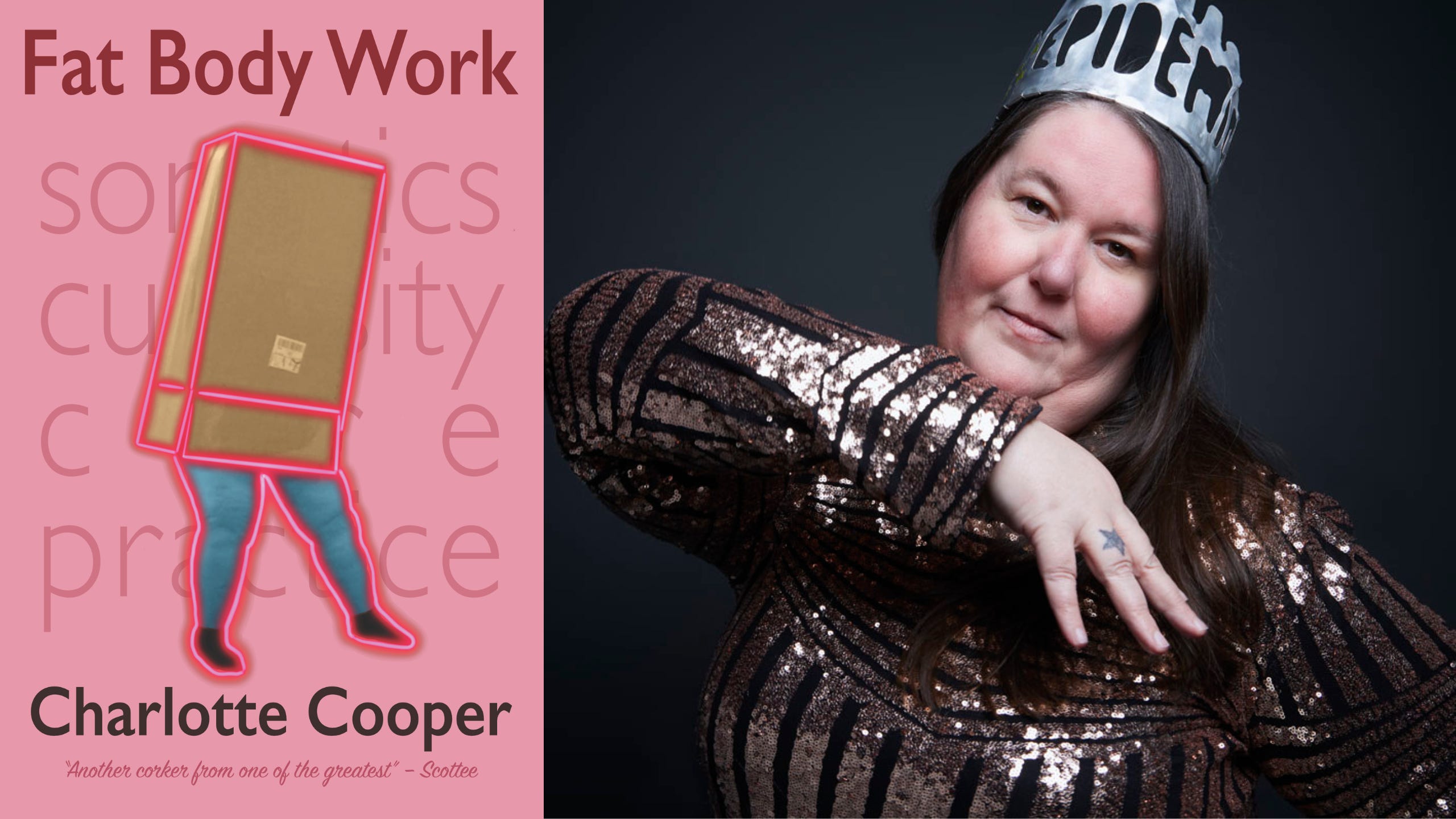
Photo by Christa-Holka
Recommendations
Learn about the ACLU and how they’re helping to block harmful government actions Right Now.
Connect with Charlotte Cooper’s work! Fat Body Work: Somatics, Curiosity, Care and Practice, is now available. Learn more about her other projects here, here and here. And then there’s Instagram.
Fat Activism: A Radical Social Movement is a great book by Cooper that I highly recommend.
More from Kimberly:

Registration for Kimberly’s 4 week online memoir workshop in July is open now with Corporeal Writing. This is for anyone doing personal writing of any kind - not just memoir.
About that trip to San Antonio Pride… Read the travel article here if you also want to visit.
Bloody Hell, edited by Mona Eltahawy, including Kimberly’s work on menopause, fat, and body changes has been released in the U.S..
Follow Kimberly on TikTok if you’re a fan of that platform. Here’s the original post about fat hatred and assault on the airplane that recently got so much interest.
You can still get the recording. Amber Karnes and Kimberly’s webinar Body Liberation: Making & Imagining.
Take a look at Kimberly’s booklists on topics like education, fat studies, memoir, etc.
Resources for book clubs and groups who want to read Kimberly’s writing
I want to take a moment to appreciate the paid subscribers to this newsletter. It takes time (and administrative support) to provide these ideas each month. If there's something here you use, or look forward to receiving, consider subscribing.
Parting words:
“I don't think we have any alternative other than remaining optimistic. Optimism is an absolute necessity, even if it's only optimism of the will, as Gramsci said, and pessimism of the intellect.”
― Angela Y. Davis
Not sure how to navigate Substack? You can read online here anytime,
And if you’re wondering how to leave a comment — just click the button above or the title of the post, scroll to the end and jump in. I love hearing your thoughts.